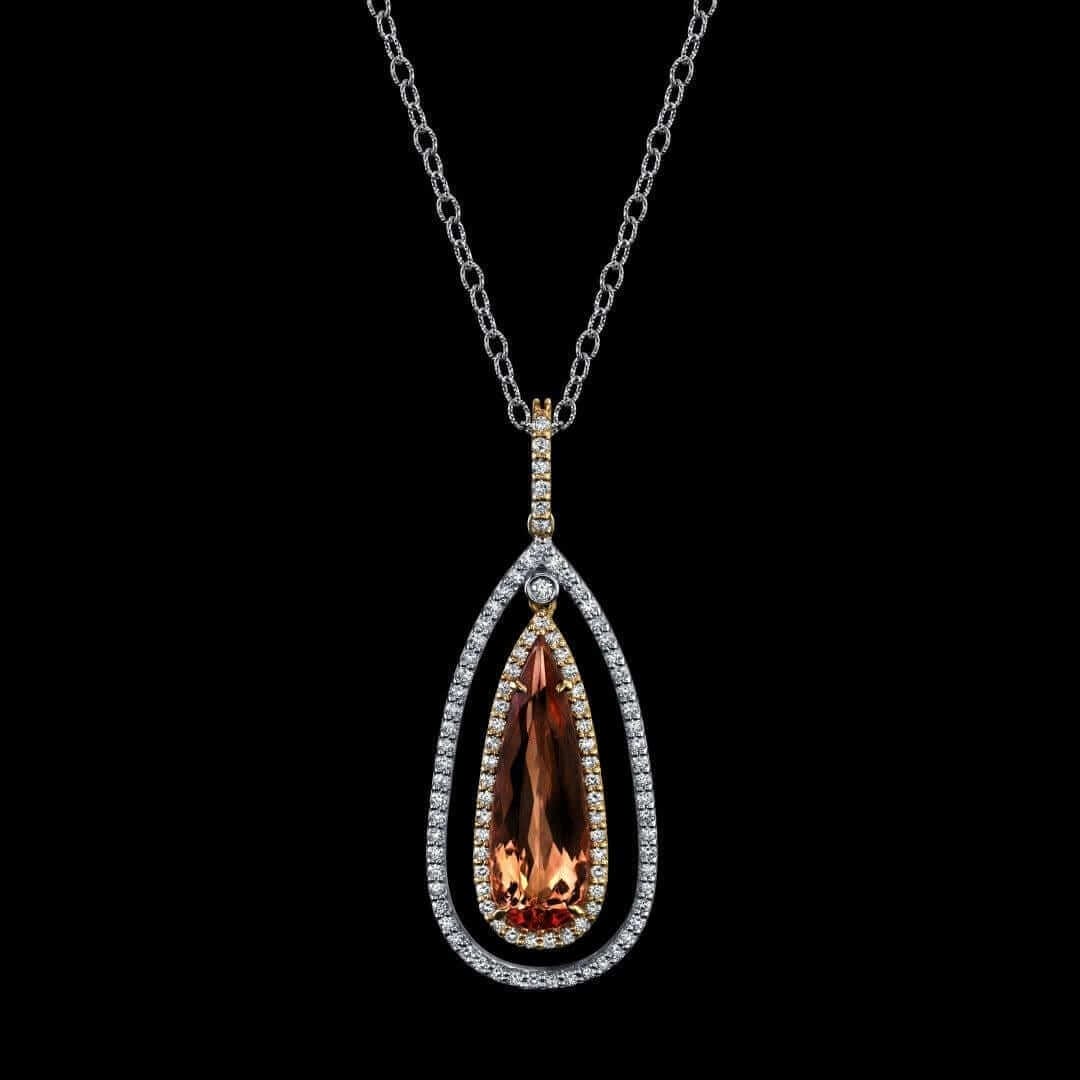
Topaz
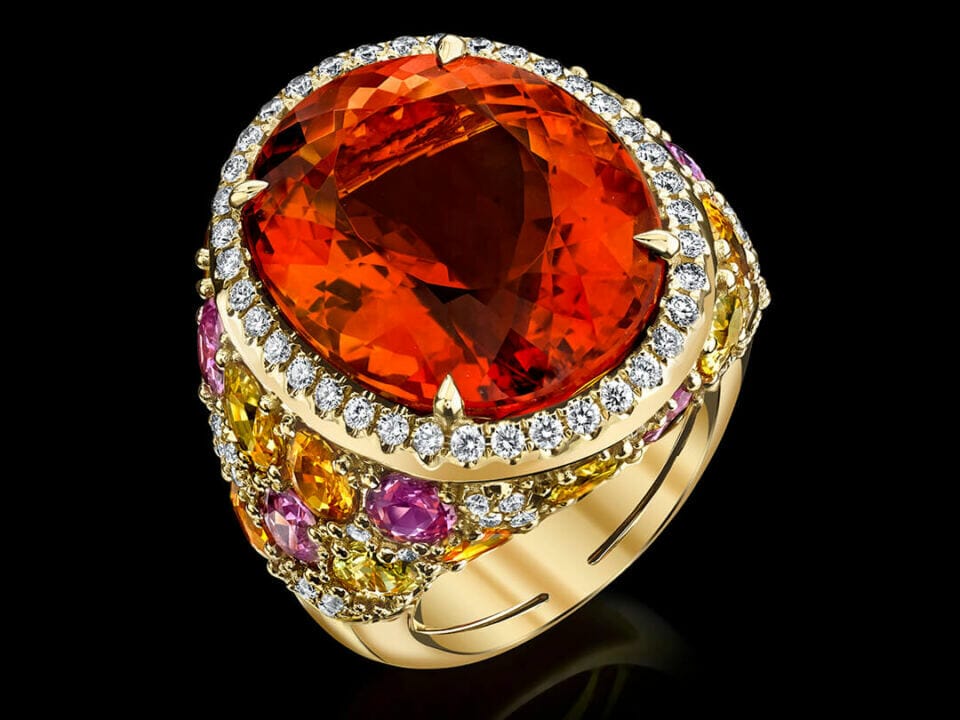
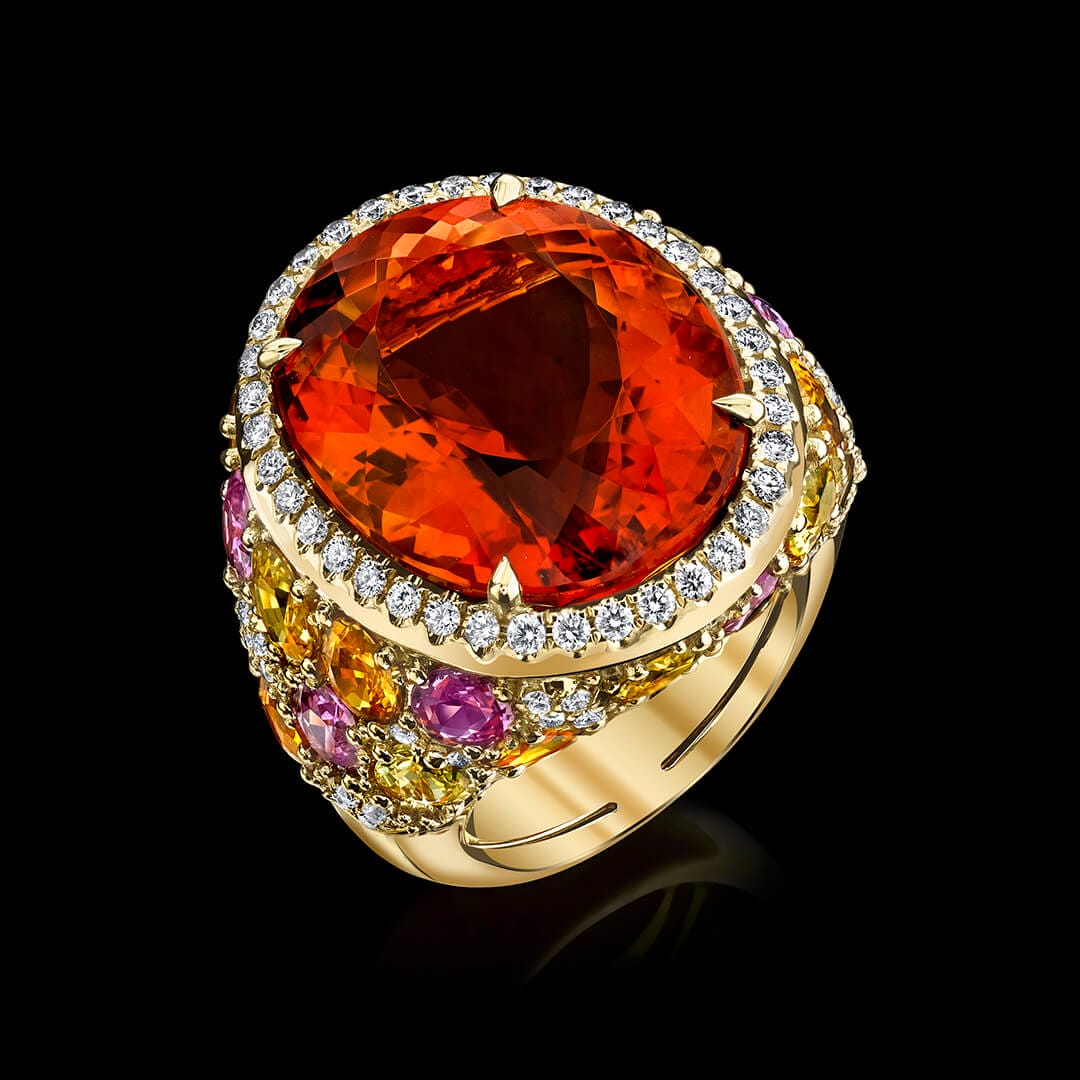
The traditional November birthstone, topaz is a popular gem. Although frequently associated with golden yellow as well as blue, it can be found in a variety of colors, including colorless. The rarest are natural pink, red, and fine golden orange, sometimes with a pink tone.
Although clarity and size have a significant effect on the value of topaz, color has the greatest impact on pricing.
The highest values go to the rare pink and red stones, then orange and yellow. Intense, reddish orange topaz is sometimes called “imperial topaz.” Yellow, orange, and brown stones are somewhat common. Colorless topazes are common and are low-value gems in any size.
The term “precious topaz” refers to stones with a rich yellow to a medium, peachy orange color.
Blue has become the most popular color for topazes on the market today. However, almost all such gems began as colorless or pale blue topazes. A safe and very common heat-and-radiation treatment gives them striking, darker colors. Blue topazes are less expensive.
Topaz Information
| Name | Topaz |
| Varieties | Imperial Topaz, Mystic Topaz |
| Crystallography | Orthorhombic. Crystals prismatic, stumpy, sometimes very large, often well formed; also massive, granular, as rolled pebbles. |
| Refractive Index | Varies by color, 1.607-1.649. See “Identifying Characteristics” below. |
| Colors | Colorless, white, gray, pale to medium blue, greenish, yellow, yellow-brown, orange, pale pink, deep pink, tan, beige, red. |
| Luster | Vitreous |
| Polish Luster | Vitreous |
| Hardness | 8 |
| Wearability | Very Good |
| Fracture | Conchoidal |
| Specific Gravity | There is a rough correlation between color and density, as follows: pink: 3.50-3.53; yellow: 3.51-3.54; colorless: 3.56-3.57; blue: 3.56-3.57. See “Identifying Characteristics” below. |
| Birefringence | Varies by color, 0.008-0.011. See “Identifying Characteristics” below. |
| Cleavage | Perfect basal (1 direction) |
| Dispersion | 0.014 |
| Heat Sensitivity | No |
| Luminescence | Blue and colorless: weak yellow-green in LW, weaker in SW, greenish white to violet-blue in X-rays, and gems turn brown due to irradiation. Sherry brown and pink: orange-yellow in LW, weaker in SW, sometimes greenish white in SW. This material fluoresces brownish yellow to orange in X-rays. |
| Luminescence Present | Yes |
| Luminescence Type | Fluorescent, UV-Long, UV-Short, X-ray Colors |
| Enhancements | Pink or red, may be heat treated. Most blue topaz has been irradiated and heat treated. CVD treatment (surface coating) used to create mystic topaz. |
| Typical Treatments | Heat Treatment, Irradiation, Surface Coating |
| Transparency | Transparent to opaque |
| Absorption Spectrum | Heat treated pink gems contain Cr and may show a Cr spectrum with a weak line at 6820. As in ruby, this line may reverse and become fluorescent. Otherwise, not diagnostic. |
| Birthstone | November |
| Formula | Al2SiO4(F,OH)2+ Cr |
| Pleochroism | Varies with color of material:
|
| Optics | RI: 1.607-1.649; biaxial (+). See “Identifying Characteristics” below. |
| Optic Sign | Biaxial + |
| Etymology | From the Sanskrittapasfor fire, alluding to the orange color, or fromTopazios, an ancient Greek name for St. John’s Island in the Red Sea where the gem was said to be mined. |
| Occurrence | In pegmatites and high temperature quartz veins; also in cavities in granite and rhyolite; in contact zones; in alluvial deposits as pebbles. |
| Inclusions | Usually planes of two or more non-miscible liquids, each containing a gas bubble. Two and three-phase inclusions have also been noted. |
From the International Gem Society