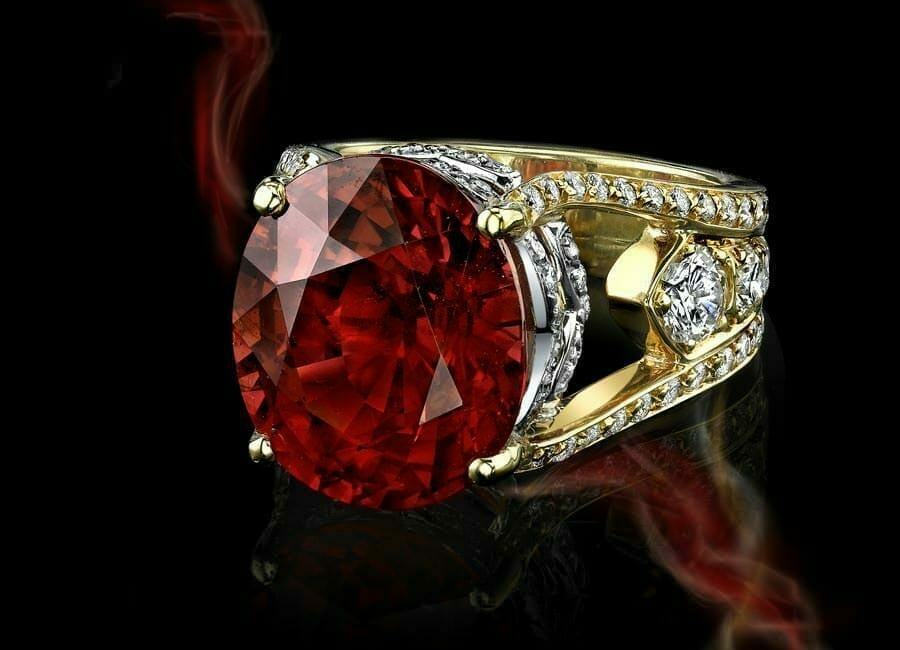
From Gem Society
Although garnet is commonly associated with the color red, these gemstones can be found in almost any color and are popular choices for jewelry of all types. That’s excellent news if you’re in the market for this January birthstone. The garnet family is one of the most complex in the gem world. It’s not a single species but rather consists of several species and varieties. This gem listing will focus on qualities common to all garnets and offer a brief overview of their diversity.
Garnet Information
| Name | Garnet |
| Varieties | Almandine Garnet, Almandine-Pyrope, Rhodolite Garnet, Andradite, Demantoid Garnet, Melanite, Topazolite, Andradite-Grossular, Mali Garnet, Color Change Garnet, Gadolinium Gallium Garnet, Grossular Garnet, Hessonite, Hibschite, Hydrogrossular Garnet, Transvaal Jade, Tsavorite Garnet, Malaia Garnet (Malaya Garnet), Proteus, Pyrope Garnet, Chrome Pyrope, Pyrope-Spessartine, Umbalite, Spessartite Garnet, Mandarin Garnet, Uvarovite Garnet, Yttrium Aluminium Garnet |
| Colors | A very wide range. See “Garnet Varieties” and “Identifying Characteristics” below and listings for specific garnet species and varieties. |
| Heat Sensitivity | Some |
| Formula | A3B2Si3O12. A = Fe, Ca, Mn, Mg. B = Al, Fe, Ti, Cr. See “Identifying Characteristics” below. |
| Etymology | From the Latin granatus for “grain.” Many garnet deposits are small grains of red crystals in or on their host rock. |
| Fracture | Conchoidal |
| Hardness | 6.5-7.5 |
| Cleavage | None |
| Crystallography | Isometric. Trapezohedron and dodecahedron forms are common. Cube and octahedron forms extremely rare. |
| Refractive Index | Varies by species, 1.72-1.95. See Gem Listings for specific varieties. |
| Birefringence | None |
| Dispersion | Varies by species, 0.014-0.057. See Gem Listings for specific varieties. |
| Luminescence | Most varieties inert. Grossulars can show a variety of fluorescence. |
| Luminescence Present | Yes |
| Absorption Spectrum | See Gem Listings for specific varieties. |
| Pleochroism | None |
| Optics | Isotropic. Some garnets may show anomalous birefringence. See “Identifying Characteristics” below. |
| Luster | Vitreous, inclining to resinous in grossular, andradite, and some almandines. |
| Specific Gravity | 3.40-4.30 (See Gem Listings for specific varieties). |
| Transparency | Transparent to opaque |
| Birthstone | January |
Unlike minerals such as beryl or corundum that are a single species with colored varieties created by trace elements, garnets come in different species and are never found in their pure state. They are always mixed with other garnet species. Garnets are called a solid-state series or a blend. Some of these blends have distinct features and are recognized as varieties of garnets in themselves. What makes them all garnets is the same crystal structure and similar properties.
Garnet Varieties
Species
For more information on these species and their own varieties, click on the links to the individual listings.
Almandine
The most common gemstone in the garnet family, almandines come in a wide range of colors. The blend of almandine-pyrope is the dark red variety popularly associated with garnets.
Andradite
One of the rarest garnets, andradites have the highest dispersion of all garnets, with even more fire than diamond. Demantoids, a variety of andradite, are especially prized.
Grossular
Unlike other garnets, grossulars are rarely red or dark in tone. However, they do occur in every color, even colorless, except blue. Their light to medium tones and vibrant colors make them excellent jewelry stones. Tsavorites have an emerald-like green color and can command high prices, while hessonite “cinnamon stones” are popular and inexpensive.
Hydrogrossular
Never transparent, hydrogrossulars are commonly blueish green in color but are sometimes found in pink, white, and gray. (Editor’s note: the classification of hydrogrossular as a garnet species is debatable).
Pyrope
Chrome pyropes show a red that can rival rubies. However, these stones have a very dark tone.
Spessartite
Also known as spessartines, spessartites are somewhat rare garnets. They come in a variety of orange colors. Mandarin garnets, a variety of spessartite with a striking orange color, are highly sought.
Uvarovite
The rarest member of the garnet family, uvarovites have a dark, rich green that rivals emerald. Facetable material is even rarer and always small.
Non-Gem Garnet Species
Non-gem garnet species include goldmanite, henritermierite, kimzeyite, majorite, schorlomite, and yamatoite. These garnets may interest collectors of rare mineral specimens.
Blends
The following blends are considered to be varieties of garnet and not sub-varieties of the above species.
Rhodolite
Rhodolites are a blend of pyrope and almandine with a distinctive purplish color.
Malaya or Malaia Garnet
This term was originally used to describe garnets that didn’t fit into standard categories. Now, gemologists recognize malaya or malaia garnets as a blend of pyrope and spessartite.
Color Change Garnet
In recent decades, color change garnets have been discovered that turn blue in artificial light. In the late 1990s, blue garnets that are red with purple flashes under incandescent light were discovered in Madagascar. These color change stones are a pyrope-spessartite blend. Some Idaho garnets show a strong color shift from red to purplish red. These are an almandine-pyrope mix.
The following species are known to blend:
- Almandine-pyrope
- Almandine-spessartite
- Andradite-grossular (also known as grandites or Mali garnets)
- Pyrope-spessartite
Identifying Characteristics
Identifying garnets is complicated. In the last fifty years, several new blends have been discovered in East Africa. There’s no reason to believe that all the possible blends have been discovered. We don’t know what the future holds for gemologists.
Garnets share common properties at the molecular level despite considerable variations. For those not scientifically inclined, here’s a visualization that, while not scientifically rigorous, may help illustrate this. If your hand were a model of a garnet molecule, all garnets would share the arrangement of atoms represented by the palm. However, the atoms represented by your fingers are interchangeable. In other words, different atoms can reside on your fingers, while the palm remains the same. Anytime you change the chemistry, you have a different species. Change the atoms of a finger and you have a different species, even though the structure and related properties remain the same (or very nearly so).
Chemistry
Of course, the chemistry of garnets varies far more than the hand model can accurately demonstrate. Below is the chemical composition of the gem garnet species.
- Almandine: Fe3Al2Si3O12
- Andradite: Ca3Fe2Si3O12
- Grossular: Ca3Al2Si3O12
- Hydrogrossular: Ca3Al2(SiO4)3-x(OH)4x
- Pyrope: Mg3Al2Si3O12
- Spessartite: Mn3Al2Si3O12
- Uvarovite: Ca3Cr2Si3O12
As you can see, there are several variations in chemistry. Nevertheless, they all maintain the same basic structure. Garnets crystallize in the isometric system. Their most common forms are the trapezohedron and dodecahedron. Curiously, they rarely appear as cubes or octahedrons, the most common shapes of other isometric minerals. Garnets may also be massive, granular, and in tumbled pebbles.
For decades, gemologists have described rhodolite as one part almandine and two parts pyrope. However, garnets are not that simple. Rhodolite gems, as well as all other garnets, have some of the other species in the mix as well. These may be present in very small amounts, but garnets are never as simple as just two ingredients. Furthermore, a solid-state series like an almandine-pyrope blend doesn’t mean that it’s a mix of two kinds of molecules, Fe3Al2Si3O12 and Mg3Al2Si3O12. Instead, it means that the structure contains both Fe and Mg.
Color
Due to garnet’s tremendous range of overlapping colors, gemologists can’t identify this gem on the basis of color alone. This information is for reference only.
- Uvarovite: dark green.
- Grossular: colorless, white, gray, yellow, yellowish green, green (various shades: pale apple green, medium apple green, emerald green, dark green), brown, pink, reddish, black.
- Andradite: yellow-green, green, greenish brown, orangey yellow, brown, grayish black, black. The color is related to the content of Ti and Mn. If there’s little of either element, the color is light and may resemble grossular.
- Pyrope: purplish red, pinkish red, orangey red, crimson, dark red. Note: Pure pyrope would be colorless; the red colors come from Fe + Cr.
- Almandine: deep red, brownish red, brownish black, violet red.
- Spessartine: red, reddish orange, orange, yellow-brown, reddish brown, blackish brown.
- Malaia: various shades of orange, red-orange, peach, and pink.
- Rhodolite: usually has a distinctive purplish color.
Care
Clean garnets with warm water, detergent, and a soft brush. Although relatively hard and tough, garnets can be heat sensitive. Avoid using extreme heat.